
Pakistan Advances Lithium-Ion Battery Policy to Boost Local Manufacturing and Energy Security
Pakistan reviews progress on its Lithium-Ion Battery Manufacturing Policy 2026–2031, focusing on local production, private investment, and energy security.
1/7/20262 min read
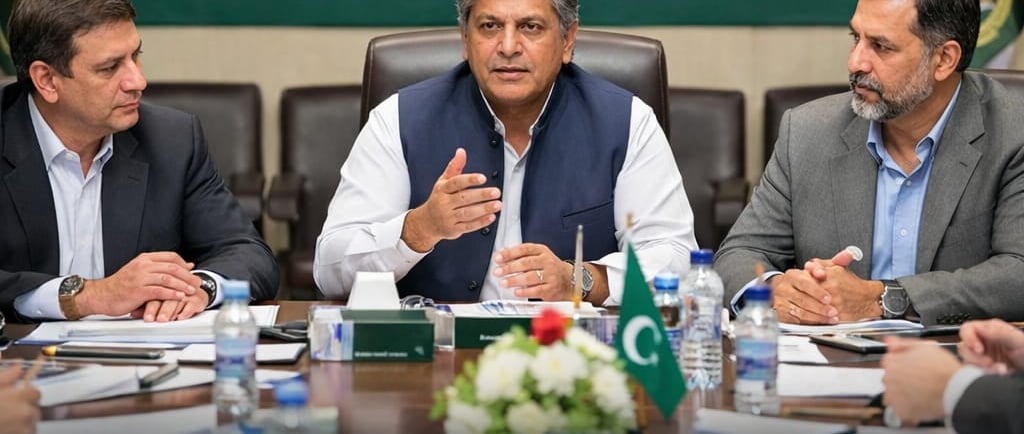
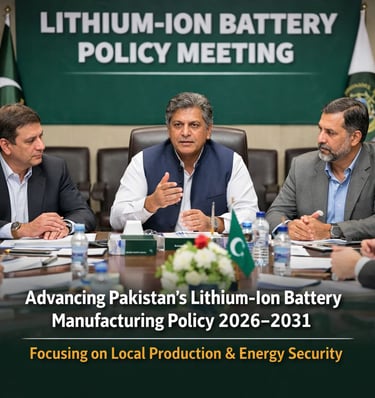
A high-level meeting on Pakistan’s Lithium-Ion Battery Manufacturing Policy was held under the chairmanship of Special Assistant to the Prime Minister on Industries and Production, Haroon Akhtar Khan, as the government pushes forward plans to strengthen local manufacturing and energy security.
The meeting was attended by Secretary Industries and Production Saif Anjum, Engineering Development Board (EDB) CEO Hammad Mansoor, along with representatives from the private sector. Participants reviewed the progress of the National Lithium-Ion Battery Manufacturing Policy 2026–2031 and discussed its implementation roadmap.
Haroon Akhtar Khan stressed that the country’s energy storage strategy must be aligned with Pakistan’s broader national energy security framework. He highlighted the importance of collaboration with private investors and international partners to ensure long-term sustainability in the energy sector.
Officials informed the meeting that a dedicated Working Group for the National Battery Policy was established on December 12, 2025. The policy framework includes phased localization targets, tariff rationalization, and performance-based incentives aimed at encouraging domestic production and attracting foreign investment.
The SAPM noted that the policy was developed through extensive consultation with federal and provincial ministries, industry stakeholders, academic institutions, and international experts. He also pointed out that Pakistan possesses reserves of phosphate, iron, and manganese, which could play a key role in supporting battery manufacturing and reducing reliance on imports.
Emphasizing safety and quality standards, Haroon Akhtar Khan said the Pakistan Standards and Quality Control Authority (PSQCA) would play a central role in ensuring compliance with global safety and performance benchmarks. He added that lithium-ion batteries are essential for a wide range of applications, including solar power systems, electric vehicles, telecom towers, and backup energy solutions.
The committee approved lithium-iron-phosphate (LFP) battery technology for initial localization, citing its safety and durability. The SAPM also underlined the need for a comprehensive system for battery testing, certification, and recycling to promote environmental sustainability.
Officials further informed the meeting that under B2B cooperation with China, several multi-million-dollar agreements related to battery manufacturing have already been signed. An upcoming meeting of federal and provincial mineral departments is also expected to enhance coordination and accelerate progress in the sector.
PK Public News provide you the latest news from all over the Pakistan so also follow our Facebook, TikTok and Instagram.
Facebook: https://www.facebook.com/share/1Qy8uykxRF/
TikTok: https://www.tiktok.com/@pk.public.news?_r=1&_t=ZS-92jAYEeLTKj
Instagram: https://www.instagram.com/pkpublicnews_1022?igsh=c3AwcnYxYnVpdm45